| (i) What is the IUPAC name for this compound?
CH3OCH2CH=CH2 |
(a) 3-methoxypropene
(b) 1-methoxy-2-propene (c) allyl methyl ether (d) methyl vinel ether (e) dihydropyran |
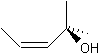
| (ii) What is the IUPAC name for this compound?
|
(a) (E)-(2R)-penten-2-ol
(b) (Z)-(2R)-penten-2-ol (c) (E)-(2S)-penten-2-ol (d) (Z)-(2S)-penten-2-ol (e) none of the above |
(iii)What is the IUPAC name for this compound?
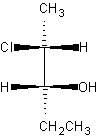 |
(a) (2S, 3R)-2-chloro-3-pentanol
(b) (2R, 3R)-2-chloro-3-pentanol (c) (2S, 3S)-2-chloro-3-pentanol (d) (2R, 3S)-2-chloro-3-pentanol (e) none of the above |
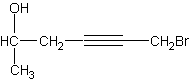
| (iv)What is the IUPAC name for this compound?
|
(a) 1-bromo-2-hexyn-5-ol
(b) 6-bromo-2-hydroxy-4-hexyne (c) 1-bromo-5-hydroxy-2-hexyne (d) 5-bromo-1-methyl-3-pentyn-1-ol (e) 6-bromo-4-hexyn-2-ol |
(a) they are levorotatory
(b) They are mirror images of R enantiomers
(c) they consist of equal parts of (+) and (-)
(d) they are dextrorotatoty
(e) the are racemic mictures
(a) In an electrophilic addition of an unsymmetric reagent to an unsymmetric alkene, the more positive portion of the reagent will become attached to the carbon of the double bond bearing the greater number of hydrogen atoms.
(b) An equatorial substituent in cyclohexane results in a more stable configuration than if that substituent were axial.
(c) E2 reactions occur only if the b-hydrogen and the leaving group can assume an anti-periplanar arrangement.
(d) When a reaction forms an alkene, and several possibilities exist, the most stable isomer is the one that predominates.
(e) The order of reactivity of alcohols in dehydration reactions is 3o>2o>1o
(a) 3-chloropentane
(b) 3,3-dichloropentane
(c) 1-chloro-2-methylpentane
(d) 2-chloro-2-methylpentane
(e) 1,5-dichloropentane
| (a) | 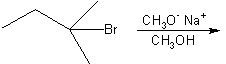 |
| NOTE: there were 3 more questions here, on topics we have not covered this year. |
(CH3)3C-O- K+ + CH3-Br ---> (CH3)3C-O-CH3 + KBr(CH3)3C-Br + CH3-O- K+ ---> (CH3)3C-O-CH3 + KBr
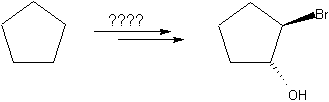
| (a) | 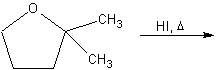 |
| (b) | one more on material we didn't cover this year |


