1. a*, b, b, e*
* = these two are ambiguous
according to the rules stated in your text, which doesn't specify the relative
priority of an oxygen vs. a double or triple bond. So 1.(i)
could be (a) or (b); 1.(iv) could be (a) or (e). (In last year's
text, there was a rule stated to deal with this.)
3. (b)
5. (d)
6. (c)
8. (a) I would accept either the elimination product (2-methyl-2-butene) or the substitution product (CH3O- replacing the Br-), or both.
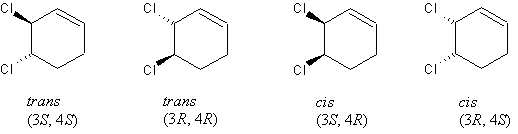
9. All 4 are optically active (there are no meso
forms). Note the typo in the original question - should be 3,4-cyclohexene.
10. Remember that the O attacks the alkyl bromide. Also remember that an SN2 reaction cannot occur at a tertiary carbon. Therefore, the top reaction, a tertiary alcohol (deprotonated) attacking a primary halide, is the better route. (The lower route will contain significant amounts of the E1 product, which is not what we want).
12. You would have to duplicate the middle structure of Figure 11.17. The middle structure of Figure 11.18 would also be acceptable.
13. My suggested route:
1. cyclopentane to bromocyclopentane (using Br2
and light)
2. conversion to alkene using base
3. halohydrin to give trans addition of Br and
OH

14. First, recognise that this is an ether, and
there are no other functional groups. Then, recognise that the reagent
will cleave the ether.
This is a bit of a tricky question,
because the book does not emphasise the point, but in fact, a tertiary
carbon may suffer an elimination during the cleavage (see bottom of p.
645), and will certainly go through an SN1 instead of SN2.
Without additional information in the question (specifying SN1
or E1), I would accept either of these mechanisms for full marks (the E1
is "more correct"):
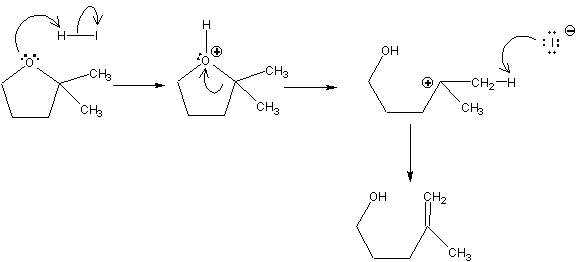
OR
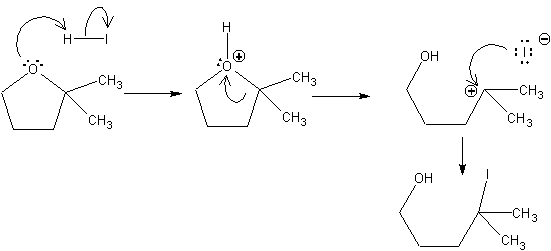
NOTE: If I specified an SN2 reaction, the product
would be different - the OH would attach to the tertiary carbon.

 |
 |
Last updated, November 5, 2003
Page maintained by Craig
MacKinnon