Exam Sample Questions (from last year)

Note: the final topic in last year's 2211 was electrophilic aromatic substitution instead of spectroscopy.  Therefore, the actual final exam was considerably longer than these questions would indicate!  It also explains the gaping holes in the question numbers.

Click here for solutions
 
1. Multiple choice: choose the best answer from the choices provided.
 
 
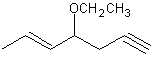
(iv) (a)  4-ethoxy-5-hepten-1-yne
(b)  4-ethoxy-2-hepten-6-yne
(c)  4-ethoxy-4-propargyl-2-butene
(d)  ethyl (1-propargyl-2-butenyl) ether
(e)  none of the above
 
(v) (a)  (R)-2-oxomethylcyclopentane
(b)  (S)-2-oxomethylcyclopentane
(c)  (R)-2-methylcyclopentanone
(d)  (S)-2-methylcyclopentanone
(e)  none of the above
 
(vi) Pentane and 2-methybutane are examples of: (a)  stereoisomers
(b)  enantiomers
(c)  constitutional isomers
(d)  diastereomers
(e)  none of these
 
(ix) Which of the following is not an oxidising agent? (a)  KMnO4
(b)  CrO3
(c)  PCC
(d)  H2O2
(e)  LiAlH4
 
(x) What is the best description of the isomer shown below?
(a)  gauche
(b)  anti
(c)  staggered
(d)  eclipsed
(e)  skewed
 
(xii) In the addition of hydrogen bromide to an alkene, which of the following species is thought to be an intermediate? (a)  an anion
(b)  a cation
(c)  a radical
(d)  a carbene
(e)  none of these
 
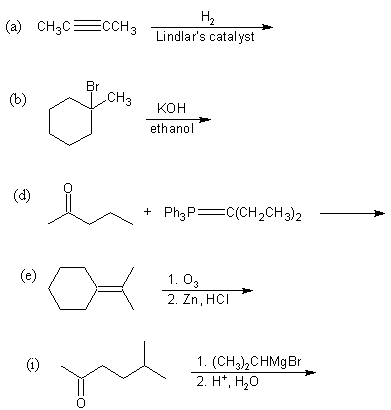
2. Predict the major (organic) products of the following reactions.

 
3. Draw each of the following structures:
(a)  a chiral molecule with the formula C5H11Cl
(b)  a chiral molecule with the formula C6H12
(c)  a meso compound with the formula C8H18
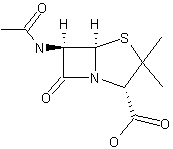
 
4. Identify the chiral carbons in the following molecule:

 
6. When optically active (S)-2-bromooctane was allowed to react with a mixture of water and ethanol, the chiral compound 2-octanol was obtained as the major product.  The optical rotation of the product was [a]obs=+6.0o.  From the chemical literature, it is known that pure (R)-2-octanol has a specific rotation of [a]obs=-10.3o.

(b)  What is the major enantiomer produced in this reaction?  Draw it (use wedge and dash lines to indicate the three-dimensional orientation).

(d)  Provide a mechanistic account of the stereochemical outcome of this reaction.

 
8. Show how cyclohexene can be synthesised from cyclohexanone.
 
9. Predict the products and give a detailed step-by-step mechanism:
(neither of these mechanisms was appropriate on last year's exam - see Exam Information for a list of mechanisms you're responsible for)

This question from last year's 2231 exam, that included the spectroscopy section of the course.  Note that the unknown compound is an ester, something we didn't do much on this semester.  I think the question I've put on this semester's exam is considerably more straightforward...
 
16. Given the following spectral data, and knowing that the molecular formula is C8H14O4, determine the structure of the unknown molecule.  Explain your reasoning by identifying the features on each spectrum that assisted with the assignment of the compound.

IR: peaks at 2986 and 1749
MS: major peaks at m/e 174 and 129
1H NMR: 4.1 ("multiplet", 4H), 3.45 (quartet, 1H), 1.4 (doublet, 3H), 1.2 (triplet, 6H)
13C NMR: peaks at 170.1, 61.2, 46.1, 13.9, and 13.5

BACK TO 2211 PAGE


Last updated, December 2, 2003
Page maintained by Craig MacKinnon