(v) d
(vi) c
(ix) e
(x) b
(xii) b
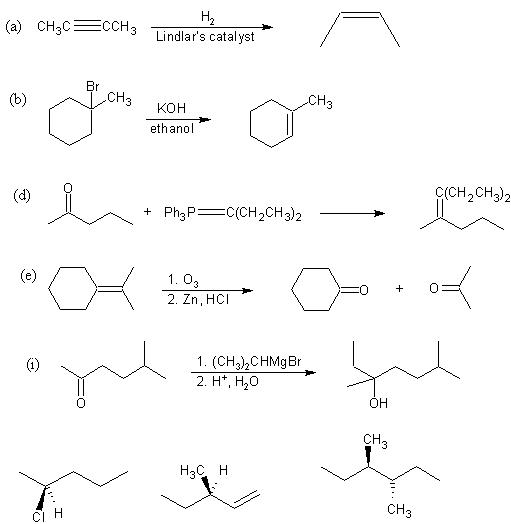
(a) a chiral molecule with the formula C5H11Cl
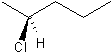 |
(b) a chiral molecule with the formula C6H12
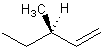 |
(c) a meso compound with the formula C8H18
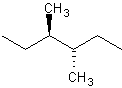
(you have to rotate about the central bond to see the mirror plane) |
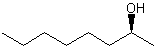
(d) If the main product has inverted stereochemistry, the mechanism must be SN2. However, it is not 100% inversion, or the rotation would be exactly opposite than of pure (R) (i.e. +10.3o). Therefore, SN1 must compete to create some (R) isomer as well.
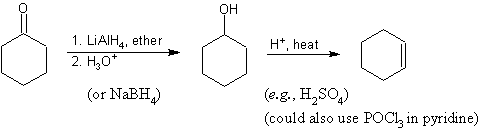
question
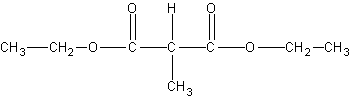
Rationale:
- There are two equivalent methyl groups (d = 1.2 ppm, 6H) and 2 equivalent methylene (CH2) groups (d = 4.1 ppm, 4H). It's logical these are 2 equivalent ethyls. The lack of extra splitting helps verify this.
- The CH2 must be bound to the O of the ester based on its chemical shift (in the alcohol/ether O-CH range of 3.3-4.5 ppm). This is verified in the mass spec - loss of OCH2CH3 from the molecule gives the peak at m/e 129.
- 13C and 1H both suggest there is only 1 type of ethyl, so there is some symmetry. 13C also confirms there is only one carbonyl (verified by the IR), so they must be symmetric. This strongly suggests there are two C(=O)-O-CH2-CH3 groups.
- There are only 2 carbons and 4 H's left to link the molecule together. 1H NMR says there must be a methyl (d = 1.4 ppm, 3H) and a C-H (d = 3.45 ppm, 1H) unit that are directly bonded (splitting patterns of these peaks). Therefore, the two equivalent ester groups must both attach to the C-H to complete that carbon's octet.
- Note: the C-H is not in the C(=O)-CH range of 2.0-2.5 ppm because it is next to TWO carbonyls, so the withdrawing effect is twice as large (therefore, the deshielding is twice as much, leading to the peak shifting to 3.45 ppm).


