(i) At what voltagewill a solution of Pb2+ be quantitatively reduced ([Pb2+] < 1.00 x 10⁻⁵M)? For Pb2+ + 2e- ---> Pb(s), E = -0.126 V (vs. SHE).(a)0.135 V(ii)Using linear-scan voltammetry, a solution that is 25.00 ppm in Cd2+ has a limiting current (Il) of 80.0 mA. What is the concentration of a solution that has a limiting current of 63.8 mA?
(b)-0.126 V
(c)-0.274 V
(d)-0.422 V(a)0.0502 ppm(iii)Americium is a synthetic element used as a radioactive source in smoke detectors. The oxidation states +6, +5, +4, +3, and 0 are all stable under certain conditions. In acidic solution, a cyclic voltammagram was run in which AmO22+ (aq) was (reversibly) reduced. If the peak-to-peak height was 0.0197 V, which is the likely product of the reduction?
(b)19.9 ppm
(c)31.3 ppm
(d)204 ppm(a)AmO2+ (aq)(iv)The familiar light blue colour of copper sulfate dissolved in water is a UV-visible absorption of Cu2+ (aq).If the molar absorptivity is 11.6 L mol-1 cm-1, what is the % transmittance of a solution that is 0.0200 mol/L?Assume a pathlength of 1.00 cm.
(b)Am4+ (aq)
(c)Am3+ (aq)
(d)Am (s)(a)0.232 %(v)For the following HPLC experiment, what is the resolution between peaks 1 and 2?
(b)4.31 %
(c)23.2 %
(d)58.6 %
|
|
|
|
|
2 |
7.2 min |
0.91 min |
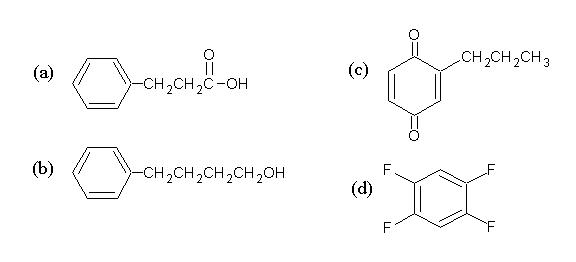
(a)1.03(b)2.07(c)14.5(d)315(vi)A unknown compound has a molecular ion with m/z = 150, and a second significant peak in the mass spectrum at 77.The infrared spectrum contains two notable peaks, a broad peak at 3200 cm-1 and a sharp peak at 1710 cm-1.Which of the following structures is the compound likely to be?
Question 1(6 points)For molecular mass spectroscopy, explain the difference between a hard source and a soft source, giving one example of each type.Be sure to comment on the type of information each source can provide about the analyte of interest.
Question 2(4 points)Explain how two of the following mass analysers (detectors) work: magnetic sector, time-of-flight (TOF), quadrupole.
Question 3(6 points)Answer one of (a) or (b).
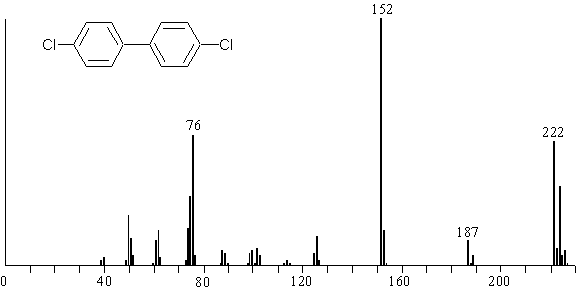
(a)CFC-11, is a (now banned) chlorofluorocarbon CFCl3, formerly used as a refrigerant.Sketch the isotope pattern for the molecular ion CFCl3+, using the following natural abundances: 12C = 100%, 19F = 100%, 35Cl = 75.8%, 37Cl = 24.2%.(b)The following is a mass spectrum for a simple PCB.Explain the fragmentation pattern by identifying the origin of the peaks at m/z 226, 225, 224, 223, 222, 189, 187, 153, 152, 76 (some comment on the relative peak heights is expected as well).Suggest a reason why no peak is seen at m/z 35 or 37.Use the following natural abundances in your explanation: 12C = 98.9%, 13C = 1.1%, 1H = 100%, 35Cl = 75.8%, 37Cl = 24.2%
Question 4(5 points)In an analysis of arsenic and copper in ground water, an ICP-mass spec analysis was done on a 100.0 mL sample of the water. 20.00 mL of 60.00 mM rhodium (103Rh) standard was added. Assuming height is directly proportional to concentration, what was the concentration of arsenic and copper in the original sample?Note that arsenic has one naturally occuring isotope (75As) while copper has two (63Cu, 65Cu) that must be summed to get the total Cu concentration.
|
|
|
|
65 75 103 |
18.94 11.16 33.61 |
Question 5(5 points each, 10 total)Answer two of the following three (a), (b), (c).(a)The standard hydrogen electrode (SHE) has a potential of 0 V, by definition.However, it is not commonly used.Explain why, and compare it to either the saturated calomel (SCE) or the silver/silver chloride electrode.(b)For a cation being reduced at a cathode, explain the steps required in moving the cation from bulk solution to the electrode, and moving the reduced species back to bulk solution.Be sure to explain the different modes of mass transfer.
(c)Explain the origin of overvoltage, and what experimental factors might give rise to increased overvoltage.
Question 6(5 points)Calculate Eo for the following reaction:AgIO3 (s) + e- ---> Ag (s) + IO3- (aq)The following information might be useful:Ag+ (aq) + e- ---> Ag (s) Eo =0.799 VQuestion 7(6 points)For one of the two cases below, choose an analytical method or methods that would allow you to identify and quantify the analyte of interest.Explain why you chose the method(s) and be sure to comment on any preliminary sample preparation that might be necessary.
AgIO3 (s) ---> Ag+ (aq) + IO3- (aq) Ksp = 3.1 x 10⁻⁸(a)Analysis of pulp effluent at a pulp-and-paper mill for steriodal compounds (small bioorganic molecules)(b)Analysis of the soil around a nuclear waste site for uranium leakage.

 |
 |
Last updated, March 20, 2003
Page maintained by Craig
MacKinnon