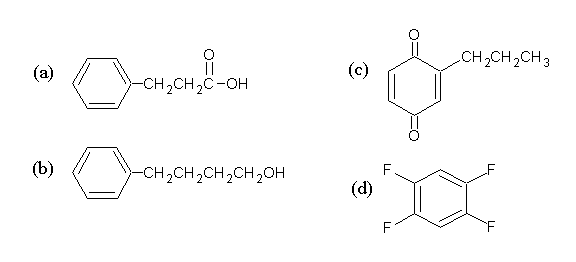
(1) A unknown compound has a molecular ion with m/z = 150, and a second significant peak in the mass spectrum at 77.The infrared spectrum contains two notable peaks, a broad peak at 3200 cm-1 and a sharp peak at 1710 cm-1.Which of the following structures is the compound likely to be?
(2) For molecular mass spectroscopy, explain the difference between a hard source and a soft source, giving one example of each type. Be sure to comment on the type of information each source can provide about the analyte of interest.
(3) Explain how two of the following mass analysers (detectors) work: magnetic sector, time-of-flight (TOF), quadrupole.(4) Answer one of (a) or (b).
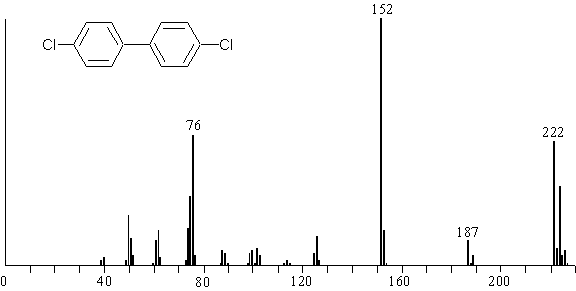
(a) CFC-11, is a (now banned) chlorofluorocarbon CFCl3, formerly used as a refrigerant.Sketch the isotope pattern for the molecular ion CFCl3+, using the following natural abundances: 12C = 100%, 19F = 100%, 35Cl = 75.8%, 37Cl = 24.2%.(b) The following is a mass spectrum for a simple PCB. Explain the fragmentation pattern by identifying the origin of the peaks at m/z 226, 225, 224, 223, 222, 189, 187, 153, 152, 76 (some comment on the relative peak heights is expected as well).Suggest a reason why no peak is seen at m/z 35 or 37.Use the following natural abundances in your explanation: 12C = 98.9%, 13C = 1.1%, 1H = 100%, 35Cl = 75.8%, 37Cl = 24.2%
(5) In an analysis of arsenic and copper in ground water, an ICP-mass spec analysis was done on a 100.0 mL sample of the water. 20.00 mL of 60.00 mM rhodium (103Rh) standard was added. Assuming height is directly proportional to concentration, what was the concentration of arsenic and copper in the original sample? Note that arsenic has one naturally occuring isotope (75As) while copper has two (63Cu, 65Cu) that must be summed to get the total Cu concentration.
|
|
|
|
65 75 103 |
18.94 11.16 33.61 |

 |
 |
Last updated, April 8, 2012
Page maintained by Craig
MacKinnon