- balancing redox reactions
- reduction potentials (Eo), electrochemical cells, cell potentials
- Nernst equation
Figure: 16-4
- the double layer near the electrode
- redox event includes
(a) mass transfer from bulk to electrode
(b) chemical reaction(s), if necessary
(c) physical state change from solution to attachment to electrode
(d) electron transfer
- any of these could be rate-determining, leading to concentration (a), reaction (b), adsorption/desorption/crystallisation (c), or charge transfer (d) polarisation
- results in overvoltage phenomenon, magnitude of which is affected by
- size of electrode
- temperature
- nature of chemical species (gas phase, soft vs. hard metal, etc.)
Figure: 20-3
- parts of the experiment that lead to observed voltage:
(a) reference electrodes
- SHE, SCE, Ag/AgCl
(b) junction (e.g.,
salt bridge)
(c) indicator electrode
- piece of metal, membrane electrode (including gas-permeable), field-effect
transistor
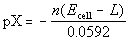
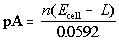
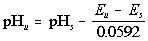
- determination of concentration using potentiometry - use
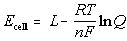
variations of the Nernst Equation:
| general form of the Nernst Equation: (L = constant, including Eo and Ej and any other incidental voltages that are constant for the cell in question) |
|
| for cation Xn+ (aq) + ne-
---> X (s) (assuming T = 298 K) |
|
| for anion A (s, l, g) + ne-
---> An- (aq) (assuming P = 1 atm, T = 298 K) |
|
| for a pH meter: (assuming P = 1 atm, T = 298 K) |
|
- to avoid solving for L explicitly, use method of standard addition
Figures: 17-2, 19-1, 19-2, 19-4, 19-5, 19-9, 19-16
Example: 19-1
(a) Electrogravimetry - reduce to solid species, weigh electrode
- determination of
separation ranges (potentials) - can the materials be quantitatively separated?
(b) Potentiostatic Coulometry - constant potential
applied, current measured, decays as analyte depleted
- (note: this
is a destructive technique)
| total charge (total number of moles of e- used): | 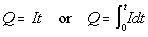
|
(c) Voltammetry - plotted as current vs. potential
- polarography =
use of dropping mercury electrode
- linear scan voltammetry
(hydrodynamic voltammetry) = amount of analyte related to limiting current
(Il)
| under conditions of concentration polarisation (cA = analyte concentration) |
Il = kcA |
- used in titrations, LC detectors (for ionic compounds), dissolved O2 content
- cyclic voltammetry - normally qualitative
- peak-to-peak width (voltage difference) = 0.0592/n
(d) Stripping Methods - high voltage reduces all analytes
(to pre-concentrate analytes)
- decrease voltage,
current will spike as analytes re-oxidise,
- voltage of re-oxidation
gives concentration
Figures: 20-5, 20-9, 20-10, 20-15


