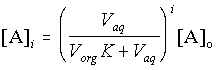
- in a 2-phase (organic/aqueous) extraction, the amount of analyte A remaining in the aqueous layer of Vaq after i extractions with Vorg is:
Example: 24-1
| (a) | Normal-phase - stationary phase is polar |
| (b) | Reverse-phase - stationary phase is non-polar |
| (c) | Ion-Exchange - stationary phase a resin capable of exchanging ions |
| (d) | Size-exclusion (SEC) - stationary phase a gel with pores,
separate by molecular volume - biomolecules a hydrophilic gel - gel-permeation chromatography (GPC) uses hydrophobic gel, used to separate synthetic polymers |
- chromatographic peaks suffer broadening
- several formulae to describe the quality of separation (resolution):
| distribution coefficient K (or Kc) for analyte A undergoing a (pseudo)equilibrium between the mobile and stationary phases, A (mobile) <===> A (stationary) | 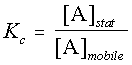
|
| retention factor k, where tR is retention time, tM is retention time of solvent, VS, VM are volumes of stationary and mobile phases | 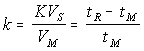
|
| selectivity factor a for two analytes A and B | 
|
| number of theoretical plates N, where H is average plate height, L is the column length, W is the width at the base of a peak, and W1/2 is the width of the peak at the half-way point of its height | 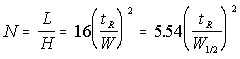
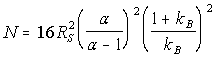
|
| resolution RS between two peaks A and B | 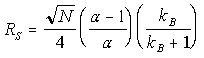
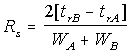
|
| length of time for second analyte B to reach the detector (centre of peak), where u is the speed of the mobile phase (L/tM) | 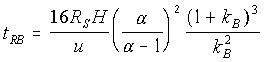
|
Figures: 24-4, 24-5, 24-6, 24-7, 24-10, 24-11, 24-12
Example: 24-2
(a) injector assembly
- mix carrier gas and sample, heated to volatilise sample
Figure: 25-4
(b) column assembly
- oven to keep column at elevated temperature to keep sample in gas phase
- mobile phase: inert gas (N2, Ar, Ne)
- column - open capillary with stationary phase on walls or packed
with stationary phase on packing material
- column made from: steel or other metal, plastic/polymer, glass
- packing material: silica gel, beads of metals, etc.
- stationary phase: normal or reverse phase
- liquid polymer attached to support (packing material or capillary wall)
- siloxanes, poly(ethylene glycol), etc.
(c) detector
- spectroscopic (mass spec, UV-visible absorption, IR, fluorescence)
- electron-capture (ECD)
- flame-ionisation (FID)
Figure: 25-5
- both quantitative (by peak area) and qualitative analysis possible, depending on which type of detector is used
Figures: 25-1, 25-9
(a) injection assembly
- sample loop - to protect syringe from pressure
- solvent reservoirs - need ultra-pure solvent
- pump - to deliver solvent at high pressure
Figure: 25-15
(b) column - steel, 10-30 cm long, could
be any type (reverse, normal, size-exclusion, or ion-exchange)
- packed with silica, alumina, polymer beads, etc.
- adsorption chromatography - no coating on packing material
- partition chromatography - packing material coated with stationary phase
- guard column before actual column - to protect, filter out particles
- no temperature ramping - may be oven to maintain constant T, usually <50oC
(c) detector
- spectroscopic (UV-vis absorption, IR, fluorescence, MS (expensive!))
- refractive index (RI)
- light scattering
Figures: 25-13, 25-17, 25-19, 25-25-20, 25-21, 25-22
- HPLC more general, more expensive, can be preparatory scale, sharper flow rate/resolution profile
- GC has more general detectors (including MS), cheaper
Figure: 24-11
(a) use of capillary:
- can use higher voltage (efficient heat disapation), therefore faster
- migration rate (v), plate count (N) directly proportional to voltage, V:
| migration rate: (me = mobility, relates to size, shape, and viscosity) |

|
plate count: (D = diffusion constant) |

|
(b) electroosmotic flow:
- glass has surface Si-O- groups, positive buffer ions (in mobile
phase) attracted to wall and cathode
- this drags solvent and solutes along
- neutral solutes dragged at same rate as solvent front
- positively charged ions move faster (solvent flow + voltage)
- negatively charged ions move slower (solvent flow - voltage)
- to stop electroosmotic flow, attach trimethylsilane (TMS) groups to capillary
wall
- to reverse, coat wall with Si-NH4+ groups
(c) capillary zone electrophoresis (CZE)
- buffer constant through capillary
- used for: proteins, pesticides/pharmaceuticals, carbohydrates
(d) capillary gel electrophoresis
- buffer contained in pores, better size selectivity than CZE
- used for DNA fragments
(e) micellar electrokinetic capillary chromatography
- add surfactant, forms micelles, micelles move more slowly (larger)
- polar molecules stay in buffer (mobile phase), non-polar go into micelles
Figures: 26-4, 26-5, 26-6, 26-7, 26-8, 26-9, and from Zumdahl (1st-year book) 23.39
- if stationary phase chiral, can separate optical isomers
- used in HPLC, electrophoresis, prep scale or analytical scale


