Textbook Questions: Set #2 - solutions
| 3-15 |
The resonance structures for each species are: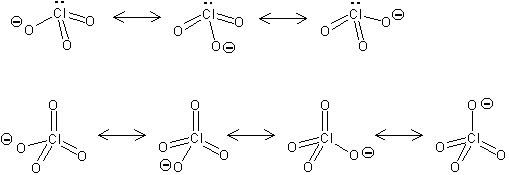 Therefore, for ClO3-, the bond order will be 1.66 For ClO4-, the bond order will be 1.75 |
| |
|
| 4-10 |
(a) Coov
(b) D2h (c) D2h
(d) Dooh |
| |
|
| 4-16 |
You should be able to get the irreducible
representation for each of the orbitals if you use the following
coordinate system: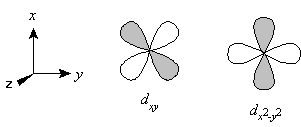 NOTE: C2 = 2 C4; C2' = along x axis; C2" = between xand y |
| |
|
| 5-1 |
Basically, this is similar to the example on p.
121. (note, by the book's labelling in Fig. 5-1, the plane of the paper
is the yz plane) Only the following three combinations
will provide a bonding/antibonding pair: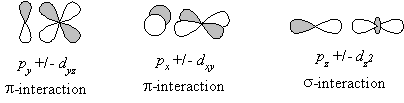 |
| |
|
| 5-2 |
For the M.O. picture, refer to Fig. 5-6(a). - For O22-, there are 14 valence electrons, to make a bond order of 1 with 3 lone pairs on each O (exactly like F2). The Lewis structure will look exactly like this, with a 1- on each O. - For O2-, the bond order will be 1.5, and the molecule will be a monoradical. The Lewis structure will not be particularly pleasant to draw! - For O2, as discussed in class, will be a diradical with bond order 2. The Lewis structure gets the bond order right, but fails to predict that the molecule is a diradical. Bond length and bond strength both increase as bond order increases. Therefore, O2 will have the strongest/shortest bond and O22- will be the weakest/longest. |
| |
|
| 5-3 |
For the M.O. picture, refer to figure 5-6(b) (no
mixing), or better yet, to your notes. Filling in 12 electrons for N22-, all levels up to the σg(nb) level are filled, and the πg* is 1/2 filled. Therefore, there are 2 unpaired electrons and the bond order is 2. This makes the N22- ion less stable (weaker, longer bond, and a diradical) than the N2 neutral molecule. |
| |
|
| 5-4 |
(a) Let's assume NO can follow the
same template as CO - i.e. that there is mixing.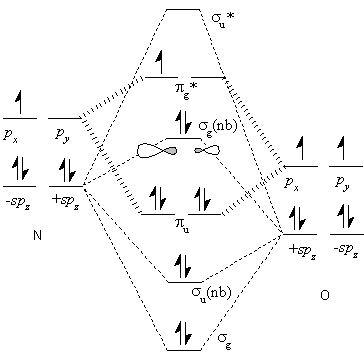 (b) The O is lower in energy, therefore O has higher electronegativity. (c) There is one unpaired electron. The bond order is 2.5 (d) NO+ will have a triple bond and the shortest bond length. NO- will have a double bond and have the longest bond length of the three species. |
| |
|
| 5-5 |
(a) CN- will certainly have mixing,
as both C and N are likely to mix. The diagram will be exactly
like that of NO except (i) the N is now lower in energy and (ii) the
single electron is not present (CN- has only 10 electrons) (b) There are no unpaired electrons. The bond order is 3. (c) The HOMO (drawn in the diagram above) is closer in energy to the C atom orbitals, therefore has a larger contribution on the C atom. Therefore, the H+ ion is likely to react with that orbital, and therefore attach to the C to form HCN. |
| |
|
| 5-6 |
It turns out that the OF- ion
actually has mixing, but you can draw it without mixing (as shown here)
and get the same answer. (a) 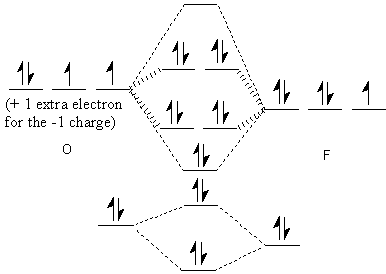
(b) The bond order is 1, there are no unpaired electrons. (c) The H+ will attach to the O atom to form HOF. The HOMO (πg*) is on the O atom because that orbital is closer in energy to the O atomic p orbitals. The compound will likely have a bent structure, because the πg* is orthogonal (at right angles) to the O-F bond (the actual experimental bond angle is 97o). |
| |
|
| 5.7 |
Actually, part (d) needs to be answered before
the M.O. diagram can be drawn. (d) The Kr should be more electronegative because it has a larger Zeff (effective nuclear charge) and therefore has lower energy orbitals. (a) Therefore, the M.O. picture should be exactly like that in 5-6, except the Kr is lower and the Br is the higher energy species. (b) KrBr+ has 14 electrons, therefore the πg* is the HOMO, which is closer in energy (and therefore polarsed toward) the higher energy Br. (c) Bond order = 1. |
| |
|
| 5-8 |
This question is exactly like the H-F question
(p. 139). Careful perusal suggests the H 1s orbital is
closer in energy to the 3p sulfur orbital.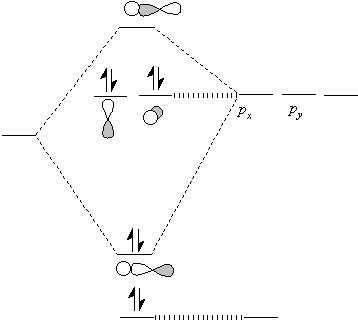 |
| |
|
| 5-17 |
CN- is more likely to form M-C bonds
because the HOMO and LUMO are both closer in energy to the C atoms,
which means that the CN- will find it difficult to bind
through the N. |
| |
|
| (5-21) |
In a square planar molecule, with the z
axis perpaendicular to the plane, the following orbitals have
σ-symmetry: dx2-y2, px, py, and s
(dz2 also has
σ-symmetry, but is unlikely to form a bond in the xy plane).
Therefore, mixing is theoretically possible between any of these
orbitals (although technically, by the point group, they do not have
the exact same symmetry), and a square-planar complex might have up to sp2d
mixing. |
| |
|
| (5-22) |
This is a little more difficult to see, because
the trigonal plane does not all lie along the x and y
axes. However, the three p orbitals, the s, and
the dz2 all have the
appropriate symmetry to form σ-bonds. Therefore, trigonal
bipyramidal is often said to have sp3d
hybridisation. (The dx2-y2 and the dxy might also
participate, to give a different type of hybridisation) |
| |
|
| 5-25 |
Cl2 will have the same M.O. diagram
as O2 (Fig. 5-6(a)) with 14 electrons in the orbitals.
Cl2+ will have 13 electrons. (a) On going from Cl2 to Cl2+, as the electron is removed from a πg* orbital, therefore the bond order will change from 1 to 1.5 (and become shorter and stronger). (b) This is a multi-atom question that isn't really appropriate for this course. |
| |
|
| 8-1 |
(a) H2+ will lose one
electron from a σg orbital, and therefore has bond
order 1/2. |
| |
|
| 8-2 |
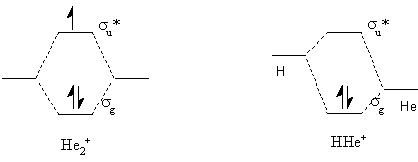 He2+ would have bond order 1/2. HHe+ would have bond order 1. |
| |
|
| (8-6) |
This is a bit of a trick question. It
turns out that the B 2p orbitals are too high to interact with
anything on the F, and the F 2s orbitals are too low in energy
to interact with the B. Therefore, the bonding looks like: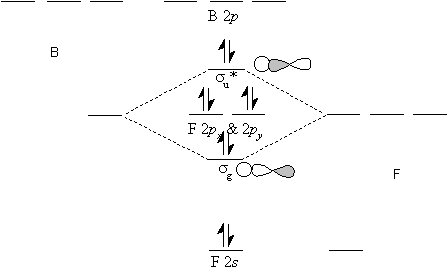 Note: by this diagram, B-F can't exist! It would have a bond order of 0. Since the question assures us that B-F can be made, we must conclude that (a) the bond is very weak and (b) the level of theory we are using is too simple to fully understand the bonding in this species. |
| |
|
| 8-27 |
(a) This question is identical to question
5-25. (b) Colour is usually a HOMO to LUMO absorption. We'll assume the HOMO is the πg* (even though it's technically not completely filled) and the LUMO is σu*. Therefore, the transition is from the πg* to the σu*. (The correct technical shorthand is σu* <--- πg*). Red colour means green is absorbed. Blue colour means orange is absorbed. Green absorption is higher energy than orange absorption (remember your electromagnetic spectrum!), therefore the Br2+ ions have a larger distance between the HOMO and LUMO. (c) The difference is that the HOMO has all fully paired electrons in I2, which it doesn't in I2+. Therefore, there is a difference in energy because (i) there is a difference in relief of pairing energy and (ii) oxidising any species causes the lowering of all M.O.'s, but s-based orbitals are lowered faster than p-based orbitals. |
| |
|
| 8-28 |
(a) They will interact at the HOMO
level because that is where the unpaired electron is. Because it
is centred on an orbital perpendicular to the first I-I bond, when the
two I2+ units come together, the new bonds will
be formed perpendicular to the original bonds, and will therefore
create
a rectangular shape. (b) The higher the temperature, the more the entropy will dominate the Gibb's Free energy (because the ΔS term is modified by the temperature: ΔG = ΔH - TΔS). Therefore, the I2+ form will dominate at higher temperature. |
SECTION 6 (crystal field theory) QUESTIONS
| 6-15 |
Hg is the softest of the three metals, and S2-
is the softest (it turns out) of the anions listed. Therefore,
the slightly harder Zn and Cd cations will be able to interact with the
soft S2-, but also with the hard carbonate, silicate, and
oxide. |
| |
|
| 9-8 |
(a) exists as mer and fac.
Make sure you can draw these! (b) there are a total of 6 isomers: - there is a set of three isomers with two cis and one trans pairing (i.e., one isomer with NH3 trans, one with H2O trans, and one with Cl- trans). - one isomer will have all species in trans pairs - one isomer will have all cis pairings. This one exists as an enantiomeric pair Δ and Λ. (c) There are a total of 8 isomers: 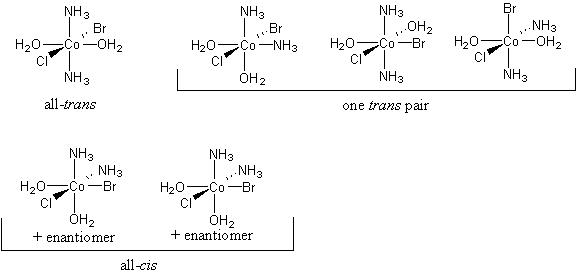 (d) These will have mer- (an enantiomeric pair) and fac- (3 isomers) types: 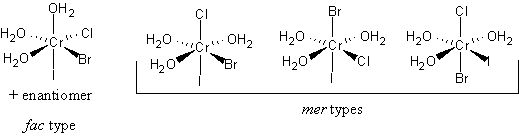 (e) If Cl- are cis, that is an enantiomeric pair, if Cl- are trans, there is one isomer (total of 3). (f) o-phen is bidentate, and must be in a cis configuration. Therefore, we get 4 total isomers: 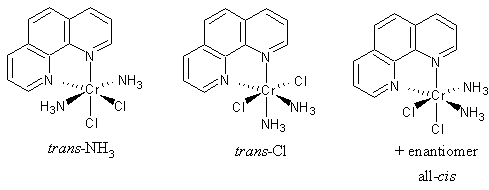 (g) bipy is also bidentate. The Br- and Cl- can be trans (one isomer) or cis (enantiomeric pair) for a total of 3 isomers. (h) dtc is bidentate, therefore (like Fe(en)3) will exist as 2 enantiomers. (i) This is the hardest of the lot. Because the two ends of the bidentate ligand are now different, this is more like a MX2Y2Z2 situation, but because X and Y are linked, it adds a further complication. There are a total of 8 isomers (6 are pairs of enantiomers): 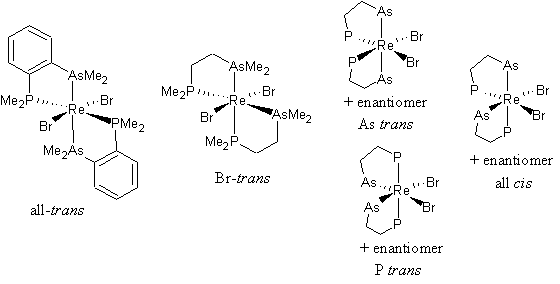 (j) dien is tridentate but can be all-cis (fac) or can look like a mer. Br- can be trans or cis to each other: 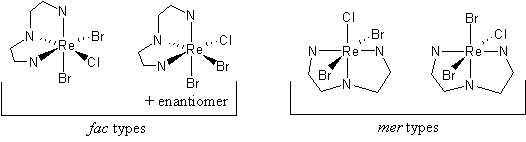 |
| |
|
| 9-15 |
(a) Δ (b) Δ (c) Λ
(d) Δ |
| |
|
| 9-16 |
(a) chiral (b) chiral if the bidentate ligand is stuck in the conformation shown (c) chiral |
| |
|
| 10-1 |
H2O is a weak ligand, so all of
these are likely high spin. (a) 4 (b) 3 (c) 3 (d) 1 (e) N2 + 2N - 5.12 = 0, solving for N = # of unpaired electrons = 4.2 Remember - 4.2 is more likely to be 5 than 4, so it's better to report 5 unpaired electrons for this |
| |
|
| 10-2 |
[Fe(CN)6]4- diamagnetic (Fe2+,
d6, likely low spin (CN- is strong)) [Co(H2O)6]3+ probably paramagnetic (Co3+, d6, H2O is weak ligand) - high spin, 4 unpaired electrons, μ = (4(4+2))1/2 = 4.90μB [CoF6]3- paramagnetic (Co3+, d6, F- very weak ligand, high spin) - high spin, 4 unpaired electrons, μ = (4(4+2))1/2 = 4.90μB [RhF6]3- diamagnetic (Rh3+, d6,metals in the 2nd row always low spin) |
| |
|
| 10-3 |
Must be more than one Fe centre if there are two
different octahedral species. Therefore, let's try multiples of
the empirical formula: - Fe2(H2O)8(CN)4 no good, can't make 2 octahedral, 1-ligand species - Fe3(H2O)12(CN)6 might work! - total number of unpaired electrons in the tripled species must be 8. Total charge on the 3 irons is 6+ to balance six CN-. - a possible structure is therefore [Fe(H2O)6]2Fe(CN)6 - Fe(H2O)62+ high spin, d6 4 unpaired electrons each (8 total) - Fe(CN)64- low spin d6, 0 unpaired electrons |
| |
|
| 10-9 |
Co2+ is d7 - tetrahedral (high spin) will have3 unpaired electrons, μ = (3(3+2))1/2 = 3.87μB - high-spin octahedral will have 3 unpaired electrons, μ = (3(3+2))1/2 = 3.87μB - low-spin octahedral will have 1 unpaired electron, μ = (1(1+2))1/2 = 1.73μB - square planar will have 1 unpaired electron, μ = (1(1+2))1/2 = 1.73μB |
| |
|
| 10-12 |
[Co(CO)4]-: Co1-,
d10, μ = 0 [Cr(CN)6]4-: Cr2+, d4, CN- is strong field (low spin), μ = (2(2+2))1/2 = 2.83μB [Fe(H2O)6]3+: Fe3+, d5, H2O is weak field (high spin), μ = (5(5+2))1/2 = 5.92μB [Co(NO2)6]4-: Co2+, d7, NO2- is weak field (high spin), μ = (3(3+2))1/2 = 3.87μB [Co(NH3)6]3+: Co3+, d6, NH3 is strong field (low spin), μ = 0 MnO4-: Mn7+, d0, μ = 0 [Cu(H2O)6]2+: Cu2+, d9, μ = (1(1+2))1/2 = 1.73μB |
| |
|
| 10-13 |
Recall that: - the stronger the σ-donor, the higher the eg set rises in energy (because it's a σ* pair) - the stronger the π-acceptor, the lower the t2g will be lowered (because it's a π-bonding orbital) According to the values of ΔE, the spectrochemical series increases down this list: Cl- = weak σ-donor F- = slighter stronger σ-bond H2O = strong σ-bond, but slightly π-donating (opposite of π-donating, which lowers Δo) NH3 = en = about same σ-bond strength as H2O, but without the bad effect of the π-donation CN- = strong σ-donor and π-acceptor |
| |
|
| 10-14 |
(a) when compressing along z, the
(antibonding) dz2 orbital
will go up
in energy (shorter distance means greater degree of antibonding
interaction) (b) when stretching along z, the (antibonding) dz2 orbital will go down in energy (longer distance means less antibonding interaction) |
| |
|
| 10-16 |
Octahedral is usually preferred because it gives
the greatest stabilisation (largest amount of bond enthalpy) - 6 bonds
formed is better than 4 bonds formed. However, with d7,
d8,d9, the formally
antibonding eg set will have electrons in it, which
will be
a destabilising interaction, especially in the case where the
Jahn-Teller
distortion is large enough to raise the dz2 orbital to intolerably high energies. |
| |
|
| 10-19 |
Cr3+ is d3 while Mn3+
is d4. Therefore, octahedreal
Cr3+ has no electrons in the antibonding eg
orbitals and no energetic reason to distort. However, the extra
electron
in Mn3+ will go into the formally antibonding eg
orbitals, so a distortion becomes energetically favourable. |
| |
|
| 10-21 |
(a) Cr2+ is d4, H2O
is weak (high spin), μ = (4(4+2))1/2 = 4.90μB (b) Cr2+ is d4, CN- is strong (low spin), μ = (2(2+2))1/2 = 2.83μB (c) Fe3+ is d5, Cl- is weak (high spin), μ = (5(5+2))1/2 = 5.92μB (d) Fe3+ is d5, CN- is strong (low spin), μ = (1(1+2))1/2 = 1.73μB (e) Ni2+ is d8, μ = (2(2+2))1/2 = 2.83μB (f) Cu2+ is d9, μ = (1(1+2))1/2 = 1.73μB |
SECTION 7 (main group chemistry) QUESTIONS
| 3-13 |
Both NH3 and NMe3 have
only σ-bonding. The angle for NMe3 is slightly larger
because the methyl groups are bigger than the H atoms and need more
space, which forces the angle open. Both Si and Ge have π-orbitals available (these are low-lying 3d and 4d orbitals, respectively). These π-orbitals can overlap with the lone pair on the N which causes the geometry to change from trigonal pyramidal (C3v) to trigonal planar (D3h). |
| |
|
| 3-14 |
Assuming the same bonding (VSEPR) structure,
all these ions should have the same bond order of 1 2/3. However,
because the size of the central atom increases in the order Cl < Br
< I, the bond length should increase in the order ClO3-
< BrO3- < IO3-, which
is what we see. The bond angle will naturally get smaller when the central atom becomes larger because (a) the bonded atoms start out further apart for a bigger atom and (b) the heavier the atom, the less likely you'll see the s orbital mixed into the p orbital (i.e. the angle should approach 90o). |
| |
|
| 3-22 |
I give the answers to all of this question,
because the explanations are relevant, even though you wouldn't
necessarily be expected to come up with the answer on your own based on
what we did in class. (a) Because there is a greater electronegativity difference between O and H than there is between S and H, the hydrogen bonding is much stronger in methanol than in methyl mercaptan. Therefore, the intermolecular bonds in methanol are stronger and it takes more heat/energy to break them and boil the liquid. (b) N2 is strictly non-polar and condensed phases (solid and liquid) are only held together by weak forces. With CO, the bond is polar, so the molecules are held together by stronger dipole-dipole interactions. (c) It turns out that o-hydroxybenzoic acid can satisfy its hydrogen bonding internally (intramolecularly), so there is no external H-bond holding the solid together. Therefore, it has a lower melting point. 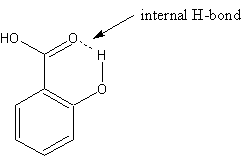 (d) "Normal" molecules and atoms held by weak forces (e.g. hydrocarbons or nobel gasses) will naturally increase as mass increases. Therefore, the nobel-gas boiling points increase as mass increases. (e) Even in the gas phase, acetic acid can for hydrogen bonds, so it forms dimers in the gas phase and reduces the expected number of moles in the gas phase. 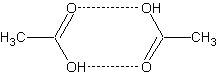 (f) Negative deviation of Raoult's Law means that the interaction between different molecules in the solution have a greater attraction for each other than they do for themselves. It turns out that the δ+ on the chloroform H will form a hydrogen bond with the lone pair on the acetone O to cause a hydrogen-bonded mixture from two components that by themselves do not form hydrogen bonds. |
| |
|
| 5-24 |
This is a regurgitation of the course notes.
Assuming sp3 hybrids, 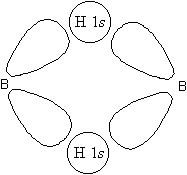 (BTW, you can do the same thing without resorting to hybrid probitals - in this case, the B 2s and 2px orbitals can both interact with the H 1s orbitals.) |
| |
|
| 8-5 |
This structure is like the B2Cl6
structure we did in class: one Cl is a "normal" Be-Cl bond, while the
other is a lone pair on the Cl donating in a Lewis acid-base
interaction into a vacant Be orbital. Therefore, there is a
formal +1 charge on the Cl and a formal -1 charge on the Be. |
| |
|
| 8-7 |
Like the H-atom, the neutral CH3 unit
has one electron left. This unpaired electron is in an sp3
hybrid (σ) orbital, and so you can draw a picture similar to that for B2H6: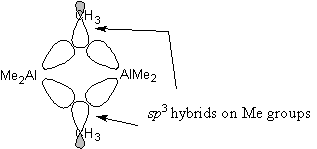 |
| |
|
| 8-19 |
As with the XO3-
series in 3-14, the central atom gets bigger as you go down the group
from N < P < As < Sb. Therefore, the bond lengths will
increase, and because the central atom is bigger, the bonding angle can
decrease and maintain the same linear distance. Also, the
likelihood of sp mixing decreases as you go down a group, so
the bonds become more purely p in character. |
| |
|
| 8-22 |
S8 is a crown-shaped circle with all
single bonds. A molecular orbital (M.O.) picture of S2
should
be similar to that of O2, which would give it a double bond,
making the S-S distance shorter. |
| |
|
| 8-25 |
Assuming the bond arrangement in I2Cl6
is essentially the same as that in B2Cl6, the
main difference in the two molecules will be the presence of lone pairs
on the I (there are no lone pairs on B). Therefore, they need to
take up space so the I atoms will not be tretrahedral (as the B's are).
If the I atoms
have three "normal" I-Cl bonds, that uses up 3 electrons, which means
each
I has 2 lone pairs. Each I has 4 actual bonds (three normal + one
Lewis
acid-base interaction) and 2 lone pairs, the base VSEPR geometry is
octahedral,
with 2 lone pairs makes square planar I atoms: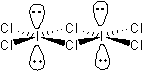 |


