Assignment #2 - solutions
| 1. |
|
||||||
| |
|||||||
| 2. (a) |
- F heavier than O, therefore unlikely to see
mixing, therefore H 1s can only interact with either F 2s or
F 2p - the energy match between H 1s and F 2p is closest in energy, therefore, that is where the interaction is |
||||||
| |
|||||||
| 2. (b) |
- N will have mixing, therefore you get:
|
||||||
| |
|||||||
| 2. (c) |
Two lone pairs are in the px and
py orbitals which are at 90o angles to
each other, therefore, they are not tetrahedrally oriented. |
||||||
| |
|||||||
| 3. |
The MO picture for C2 would be (with mixing!):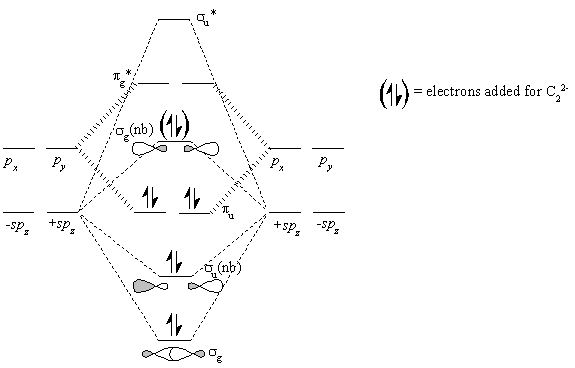
|
||||||
| |
|||||||
| 3. (a) |
The bond order (for C2) is 3, if you count
the σu(nb) as a non-bonding orbital. |
||||||
| |
|||||||
| 3. (b) |
The bond order of C22- is still
3, because the extra 2 electrons went into a non-bonding orbital. |
||||||
| |
|||||||
| 3. (c) |
The HOMO is an orbital that has electron density
pointing out at 180o angles from the C-C bond. Therefore,
because this is the orbital with the correct linear geometry and because
the energetics will be favourable, the HOMO will interact with H+ to form
a C-H bond. (It turns out that the σu(nb) is also
used for C-H bonding - to form two C-H bonds requires two M.O.'s on the C22-
fragment.) |


|

|
Last updated, April 4, 2005
Page maintained by Craig MacKinnon