(ii) one of the following: B&C, B&E, C&D, or C&E
(iii) one of C or E
(iv) one of A or F
(v) C and E
One point per question.

(ii) ester reduction/cleavage - molecule breaks at the single bond from the oxygen to the carbonyl carbon.

One point per structure. If you switched the Br and OH in (i), you lost 1 point.
1 point: allyl can rearrange (or the radical is stabilised by resonance structures)
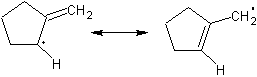
1 point: internal alkene is energetically favourable compared to terminal alkene, so that is the final product (note: it does not rearrange to form the most stable intermediate)
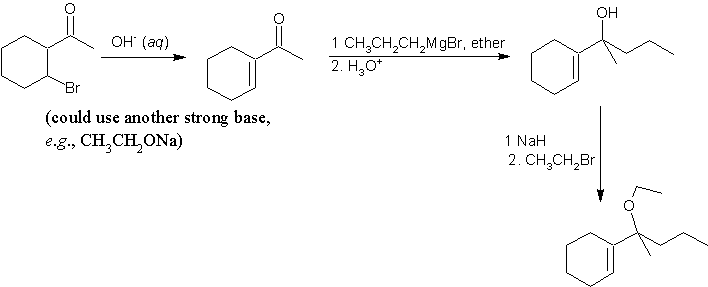
There are 3 fundamental transformations (addition of propyl, conversion to ether, and dehydroalkylation to give alkene), each worth 1.5 points. The final 0.5. points was awarded for logical order in the sequence (e.g., trying to dehydrobrominate in the presence of OH probably won't work because there are two acidic sites for the base to attack).
| (a) | This is a tertiary alkyl halide, so first step will be unimolecular
loss of the Cl- to create the carbocation (CH3)3C+.
At this point, the water can either act as a nucleophile and attach at the carbocation in an SN1 reaction to create the first product. Otherwise, the water can act as a base to extract an H+ from an adjacent carbon and form the E1 product (the second product) 2 points for identifying the carbocation intermediate, and that it's the same for both products 1.5 points each for identifying the type of mechanism that leads to each product. |
| (b) | This is also a tertiary alkyl halide, and in fact you should get the
same two reactions (SN1 and E1) that occurred in part (a):
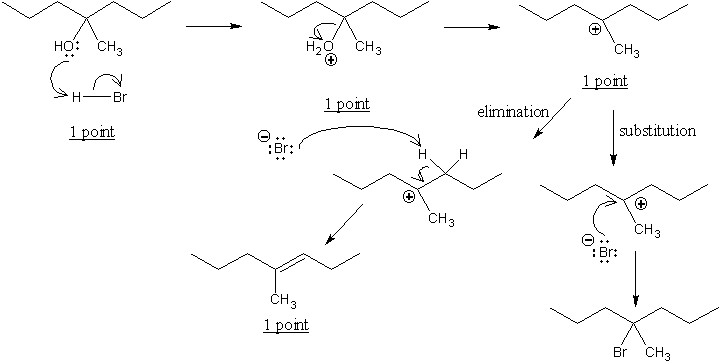
Note: neither the starting material nor either product is chiral. |
| (c) | 1 point: if the product is ethanol, must go by an elimination
reaction
1point: if E1, would get 2 products (2-methylcyclohexane and 3-methylcyclohexane), therefore must be E2 1 point: the H that is lost must be trans to the Br (anti periplanar) 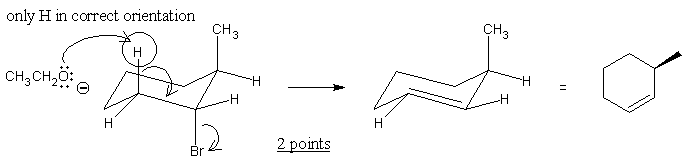 |


