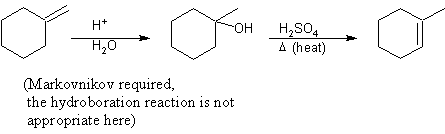
The reactions are, in fact, different. Step 1 uses dilute aqueous acid
to hydrate the less stable terminal alkene. The second step uses concentrated
strong acid and heat to generate a more stable internal alkene.
Note: for this question, simply including a correct reagent (such as acid
to perform a dehydration reaction) does not give you any points unless it
makes sense to act with that agent on the molecule (dehydration only works
on alcohols).
There is another route using Markovnikov addition of HBr and then dehalogenation
with strong base (e.g., CH3O-).
| (i) | 
(1 point for putting in a double bond, 1 point for putting it in the correct spot) |
| (ii) | 
(1 point for recognising this adds H and OH across a double bond, 1 point for knowing it stops at one alcohol and then undergoes keto-enol isomerisation to the final product) |
| (iii) | 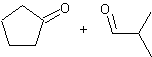
(1 point for each) |
| (a) |
(ii) trans |
| |
|
| (b) |
1 point for double bond acting on the Br2 Points were lost for things like single-headed arrows, forgetting proper formal charges, etc. If you circled (i) or (iii) for Part (a), you lost points if your mechanism did not account for your choice there (for example, if you showed the correct mechanism to form the trans product, but predicted cis, you lost marks for that). |



